
India's political infighting is denting business confidence.
GDP growth of 7.7 per cent in the first half of this fiscal has "left sceptics gasping and woefully behind the curve", an RBI article said on Wednesday. It also stressed the buildup in the growth momentum is likely to be sustained. The article on the state of the economy published in the Reserve Bank's December Bulletin on Wednesday also said CPI-based retail inflation is expected to ease to 4.6 per cent in the first three quarters of 2024-25 from 5.6 per cent in November.

The policy review observed that the moderation in inflation, excluding food and fuel, that was witnessed in the first quarter of 2017-18 has "by and large, reversed".
The RBI in its monetary policy review in October has revised the inflation forecast to 6.5 per cent by March-end from 5 per cent earlier.

The repo rate, at which the central bank lends to the system, will come down to 5.75 per cent after the cut.

In the mid-quarter review on December 18, the Reserve Bank left key policy rates unchanged but said it will hike interest rates if inflation does not subside.

If imputed inflation for April and May is used, then you have inflation of over 6 per cent for two consecutive quarters, which is a worrying signal for the RBI.

The interest rates on deposits continue to be high despite ample liquidity due to monetary policy uncertainty and expectations that liquidity would tighten later this year. Banks are still offering peak interest rates of 9 to 9.5 per cent on deposits

As the Indian economy started getting impacted by the global financial crisis, RBI cut its short-term lending rate (repo) by 4.25 percentage points to 4.75 per cent and borrowing (reverse repo) by 2.75 percentage points to 3.25 per cent.
RBI is scheduled to announce the annual credit policy on May 3.

'Whether I am optimistic or pessimistic is not the issue; I am just going by the evidence available.' 'The Indian economy and financial sector are now well-placed and very resilient in dealing with any kind of spillover coming from the external world.'

Acharya was one of the youngest deputy governors in the central bank's history and was in charge of the critical monetary policy department which also made him a part of the rate-setting panel.
Tuesday's policy announcement had a regulatory and development component.
It further pointed out that the twin balance sheet problem -- at the end of banks and corporate -- more attractive interest rates for borrowers in the bond market and from non-banking financial institutions are other reasons for slow bank credit growth.

There is evidence of asymmetric adjustment to monetary policy

'Normally, the system is geared towards counting notes -- it is equipped to do x amount of work and one day you are asking them to do 20 x.' 'The processes involved are very complex.'

The Asian Development Bank (ADB) on Wednesday slashed India's GDP growth forecast for FY23 to 7 per cent from the earlier estimate of 7.2 per cent mainly on account of higher inflation and a tight monetary policy. India's economy grew 13.5 per cent year-on-year in the first quarter of 2022-23, reflecting strong growth in services, ADB said in its second supplement to Asian Development Outlook Report 2022 (ADO 2022). "However, GDP growth is revised down from ADO 2022's forecasts to 7 per cent for FY2022 (ending March 2023) and 7.2 per cent for FY2023 (ending March 2024) as price pressures are expected to adversely impact domestic consumption, and sluggish global demand and elevated oil prices will likely be a drag on net exports," ADB said.

The central bank and Indian government has reached a "broad consensus" on the composition of a rate-setting panel.

The RBI kept interest rates unchanged at 8 per cent as widely expected.
200 staffers, consisting of RBI officials and support teams, who are essential to perform critical functions, were isolated at a separate facility in a dedicated quarantined environment near all three RBI data centres.
'A strong foreign exchange reserve is the best safety net against global spillovers.'
In its Third Quarter Review of Monetary Policy 2012-13, the Reserve Bank of India has reduced the policy repo rate under the liquidity adjustment facility (LAF) by 25 basis points from 8.0 per cent to 7.75 per cent with immediate effect.

All policy planners want low interest rate, says Jaitley

Reserve Bank Deputy Governor Michael Patra on Wednesday said the central bank's views about cryptocurrencies might have delayed the government's proposed legislation on crypto assets. Emphasising that the Central Bank Digital Currency (CBDC) will be introduced in FY23 as announced by Finance Minister Nirmala Sitharaman in the Budget speech, Patra said India will proceed very gradually on the subject as there are concerns on privacy, its impact on monetary policy formulation and energy intensity. The government had plans to introduce a bill on cryptocurrencies like Bitcoin during the Winter Session of Parliament in November-December 2021 but did not introduce it.

The RBI on Friday said the impact of coronavirus outbreak on the economy will depend on the intensity, spread and duration of the deadly virus even as the central bank refrained from projecting any numbers for growth and inflation amid the widespread uncertainty. While announcing the seventh bi-monthly monetary policy statement for 2019-20, RBI Governor Shaktikanta Das said that in view of the impact of coronavirus pandemic, the growth projections for 4.7 per cent for the fourth quarter of 2019-20 and 5 per cent for the full fiscal are "now at risk".

Endorsing Finance Minister P Chidambaram's call to banks to pass on the benefit of rate cuts to customers, RBI Governor D Subbarao on Thursday said the central bank is also "very conscious" of the need to be supportive of economic growth.
Reserve Bank has lowered interest rates by 0.50 per cent since January 2015.

The apex bank, however, may not aggressively tighten the monetary policy and is likely to resort to only a moderate 0.25 per cent hike in short-term borrowing rates and mandatory bank deposits with RBI, bankers said.
Shares of Anil Ambani-led Reliance Communications and Reliance Infrastructure gained five per cent each on expectation that rate cuts would help lower the interest cost burden of these companies.

RBi pushes for reinvigorating private investments, clearing infra bottlenecks and providing big thrust to Pradhan Mantri Awas Yojana.

Prices of food items like cereals, pulses, and edible oils rose or remained steady in May, a Reserve Bank of India (RBI) report said, indicating there could be another higher inflation print. However, it observed that the Monetary Policy Committee's (MPC's) surprise move to increase interest rates bodes well for its credibility. The RBI's monthly State of the Economy report, released on Tuesday, citing high frequency food price data from the Ministry of Consumer Affairs for the period May 1-12, said the increase in the prices of cereals was primarily because of the surge in wheat prices.
The Reserve Bank of India's tight monetary policy is expected to moderate India's economic growth rate to 8.1-8.6 per cent in 2008, against 8.5-9 per cent in 2007, Global rating agency Standard and Poor's said on Wednesday.
The Reserve Bank on Thursday said the country's wholesale price-based inflation and industrial production data should be improved and employment data availed for effective monetary policy management.
The continuing global uncertainity has complicated the fight against inflation, opined Reserve Bank Deputy Governor Michael Debabrata Patra during the Monetary Policy Committee meeting held on February 8. According to the minutes of the MPC meeting released on Wednesday, RBI Governor Shaktikanta Das also mentioned that there is considerable uncertainty due to a host of global factors such as rising non-oil commodity prices. The RBI on February 8 hiked the key short-term lending rate by 25 basis points to 6.5 per cent, citing sticky core inflation.

Falling core inflation on the back of slowing economic growth is likely to create space for the Reserve Bank to ease monetary policy in the early part of the next year, rating agency Crisil said.

Raghuram Rajan said a six-member monetary policy committee will decide on interest rates.

The Reserve Bank of India may consider withdrawing excess liquidity in the system to tame high inflation in its monetary policy review later this month, Suresh Tendulkar, economist and former head of the Prime Minister's Economic Advisory Panel, said on Tuesday.
Former Reserve Bank Deputy Governor S S Tarapore on Thursday said that the apex bank should not lower its repo and cash reserve ratio rates in its forthcoming monetary policy review.

The banking sector in India is reeling under Rs 8 lakh crore of non performing assets (NPAs) or bad loans, of which PSU banks alone account for over Rs 6 lakh crore.
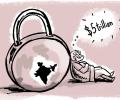
India is much better placed today to deal with future waves of the pandemic relative to the first wave, RBI deputy governor Michael Patra said.
